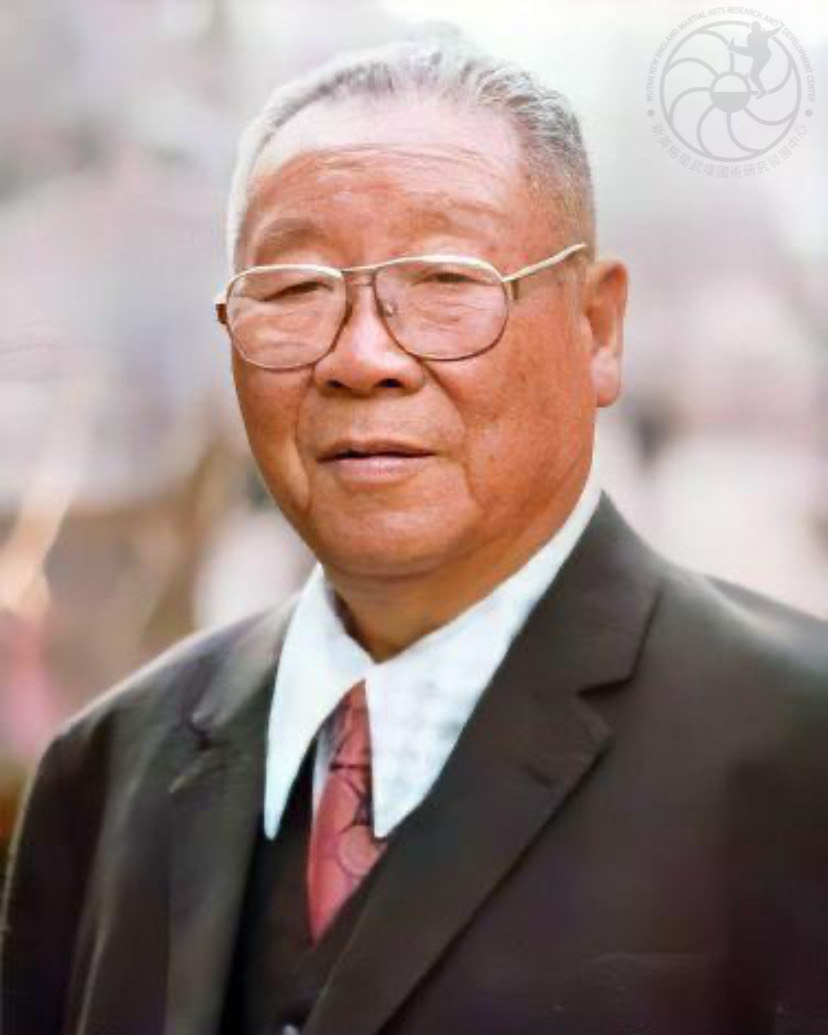
The Sole Custodian of Six Harmonies Mantis in Taiwan
Zhāng Xiāng Sān (張詳三), formal name Zhāng Xíyì (張習易), style name Xiāng Sān, was born in 1900 in Huángxiàn County (黃縣, now Lóngkǒu Shì 龍口市), Shandong Province. He passed away on February 24, 1982, in Taipei, Taiwan, having lived 82 full years — years devoted almost entirely to the study, preservation, and transmission of traditional Chinese martial arts. He is recognized by all major Chinese and Taiwanese martial arts scholarship as the foundational figure of Six Harmonies Praying Mantis Fist (Liùhé Tánglángquán 六合螳螂拳) in Taiwan, and as one of the most important custodians of Shandong martial arts traditions in the twentieth century.
For over thirty years — from his arrival in Taiwan in 1949 until his death — Zhāng Xiāng Sān taught daily at Taipei's New Park (Táiběi Xīn Gōngyuán 台北新公園, now 二二八公園), maintaining the discipline and openness of a traditional Shandong martial arts hall in the heart of a modern capital. The Wu Tan Taiwan record describes him simply: "the sole custodian of Six Harmonies Mantis in Taiwan — teaching students there, thirty-plus years without a single day's interruption." In that time he trained over a thousand students, accepted thirty-one formal inner-chamber disciples, authored six published books, helped found Taiwan's provincial martial arts governance structure, and personally established the institutional framework for Mantis Fist's continued survival on the island.
From a Shandong Boy to a Master's Most Trusted Deputy
Zhāng Xiāng Sān's love of martial arts manifested from earliest childhood. At age seven, he began accompanying his elder brother to the martial arts hall — not yet formally enrolled, but already captivated by what he saw there. The Six Harmonies Mantis tradition he would encounter was already concentrated in Huangxian through the person of Dīng Zǐchéng (丁子成, 1880–1956) — the wealthiest patron-practitioner of Shandong martial arts, whose pawnbroking family wealth had allowed him to bring the Mantis lineage holder Lín Shì Chūn to Huangxian and study under him for decades.
At age twelve, Zhāng Xiāng Sān formally became Dīng Zǐchéng's disciple, beginning an apprenticeship that would span more than two decades of unbroken study. He studied under Dīng for over twenty years — and for more than ten of those years, he served as Dīng's substitute teacher (dàikè 代課): the master's trusted deputy who could step in to instruct when Dīng himself was unavailable. This role of deputy-instructor, held for a decade, reflects an extraordinary level of technical mastery and personal trust. By the time Zhāng left Huangxian, he had not merely absorbed the curriculum — he had spent years transmitting it to others, deepening his own understanding through teaching.
Alongside his primary Six Harmonies training, Zhāng also studied Seven Stars Mantis (Qīxīng Tánglángquán 七星螳螂拳) under Cáo Zuòhòu (曹作厚) — a Seven Stars lineage holder with a mule-trading business in Yantai, known as "West Tyrant of Heaven" (西霸天). The two Mantis masters were on friendly terms through the Huangxian martial community, and had exchanged their respective arts — Cáo learned Six Harmonies from Dīng; Dīng's disciples including Zhāng and Zhào Gāngyī (趙乾一) learned Seven Stars from Cáo. This dual lineage meant that Zhāng carried both the soft and the hard expressions of the Mantis tradition simultaneously — and ensured that subsequent generations of his disciples would receive both branches.
The 93-Technique Secret Hand Formula
The most significant material object in the history of Six Harmonies Mantis Fist's preservation is a handwritten manuscript — and its story passes directly through Zhāng Xiāng Sān's hands. When Zhāng prepared to leave Huangxian for the last time, his teacher Dīng Zǐchéng did something extraordinary: he personally handed Zhāng a manuscript written in his own hand, encapsulating the complete technical wisdom of his lifetime's practice.
The significance of this manuscript cannot be overstated. At a time when mainland China's traditional martial arts were being suppressed during the Cultural Revolution, this written record — preserved first in Zhāng's hands, then in the Wu Tan system's custody — served as a bridge ensuring the art's survival. The manuscript's eventual return to Shandong represented not just a cultural repatriation, but proof that Taiwan had served as a living archive for a tradition that might otherwise have been irretrievably lost.
A Complete Shandong Martial Education
Zhāng Xiāng Sān was far more than a single-art specialist. His martial education represented the breadth of the finest Shandong tradition — encompassing the full Six Harmonies Mantis curriculum, two branches of Mantis Fist, multiple sword systems, and original contributions to Taijiquan. He published books covering each of these systems, making him one of the most prolific martial arts authors in twentieth-century Taiwan.
On the Cultivation of Martial Arts
Zhāng's teaching approach was consistent with the deepest traditions of classical martial transmission — demanding, selective, and structured around earned trust. He personally stated: "Praying Mantis Fist has long been cherished by our people; I have practiced it since childhood — but the knowledge cannot simply be shown to anyone." His curriculum had a graduated structure: students who had not yet entered the formal discipleship received the first four of the Six Harmonies form sets (Tiě Chǐ 鐵齒, Shàn Shǒu Bēn 善手奔, Jìng Lǐ Cáng Huā 鏡裏藏花, Jié Shǒu Quān 截手圈). Only upon formal discipleship were students permitted to learn the final two sets (Yè Dǐ Cáng Huā 葉底藏花 and Shuāng Fēng 雙封), and the Yànlíng Dāo (雁翎刀 — Wild Goose Feather Saber) was taught exclusively to inner-chamber disciples.
Thirty-Three Years at New Park
When Zhāng Xiāng Sān crossed to Taiwan in 1949 with the Republic of China government, he arrived in a city that was rapidly becoming an unexpected sanctuary for traditional Chinese martial arts. Taipei's New Park (台北新公園) had already established itself as a gathering point for practitioners — and Zhāng immediately claimed his place there, establishing what would become one of the park's most enduring and respected teaching posts.
For more than three decades, Zhāng's teaching there was the sole source through which Six Harmonies Mantis Fist survived on the island. He participated actively in building the infrastructure for organized martial arts in Taiwan: helping found the Taiwan Provincial Martial Arts Association (Táiwān Shěng Guóshùhuì 台灣省國術會), serving as director, executive director, and acting chairman in succession; serving as Chief Judge at the 2nd Taiwan Provincial Martial Arts Competition; and contributing as a compilation committee member to the Ministry of Education's Martial Arts Encyclopedia — a foundational reference work for Chinese martial arts scholarship.
The most famous story of the Taiwan years is the reunion with Liú Yúnqiāo. The Wu Tan Taiwan primary record preserves the moment: around 1966, at New Park, Zhāng overheard two strangers debating which city "their" Liú Yúnqiāo came from — one saying Cangzhou, the other Tianjin. Zhāng smiled and offered a third answer: "Might it not be my martial brother, our Shandong Huangxian Liú Yúnqiāo?" A fellow townsman present knew Liu was in Taiwan, and arranged the introduction. "The two clasped hands — it was as if a lifetime had passed in an instant." This reunion renewed both men's martial lives: Zhāng introduced several of his disciples to Liú Yúnqiāo for training in the Wu Tan system — the Six Harmonies Mantis curriculum and the Baji-Pigua-Bagua curriculum thus flowing together through the same generation of Taiwan practitioners.
Six Books — A Literary Legacy
Zhāng Xiāng Sān was among the most prolific martial arts authors of his generation in Taiwan. Recognizing that oral transmission alone could not guarantee survival across generations, he committed his technical knowledge to print in multiple complete authored volumes — covering each of the major arts in his curriculum. His books were not simplified summaries but full technical manuals intended for serious practitioners, published and circulated across Taiwan during his lifetime.
Building the Foundations of Taiwan Martial Arts
Zhāng Xiāng Sān's contributions to Taiwan's martial arts extended far beyond the teaching platform in New Park. He was a tireless institutional builder — participating in the creation of every major martial arts governance structure that emerged in Taiwan during the second half of the twentieth century.
Thirty-One Inner-Chamber Disciples Across Taiwan
During his thirty-three years of teaching in Taiwan, Zhāng Xiāng Sān trained over a thousand students in total — and accepted thirty-one into the formal discipleship relationship (bàitiě dìzǐ 拜帖弟子) that constituted the Seventh Generation of Six Harmonies Mantis Fist (liùhé tánglángquán dì qī dài 六合螳螂拳第七代). These disciples were distributed throughout Taiwan, continuing the art in different cities and communities after his death. Among the most significant were:
A notable detail preserved in the Six Harmonies Mantis Taiwan records: when Zhāng passed away on February 24, 1982, there were two prospective disciples who had not yet formally been accepted. His martial brother Liú Yúnqiāo — in a final act of fraternal respect — stood before Zhāng's memorial altar on March 17, 1982, and accepted Yú Jísūn (俞吉蓀, deceased) and Shěn Hóngjī (沈宏基) into the Mantis lineage in Zhāng's place. That Liú would take this role — bridging two lineages in one gesture at a funeral altar — speaks to the depth of the bond between the two Huangxian martial brothers, and to Liú's recognition of Zhāng's lineage as equally legitimate to his own Wu Tan transmission.
The teaching ground Zhāng established at New Park did not die with him. His disciple Chén Wēishēn continued instruction at the same location, later moving to Tianmu Park in 1987 and to Neihu Shitan Park in 2011. In 2018 the lineage training ground relocated to the Taipei Tennis Center — its current home where Chén Wēishēn's students still gather after his passing in 2024. A site that began with one man teaching under the open sky in 1949 remains active today, three quarters of a century later.