
The Man Who Carried a Tradition Across the Taiwan Strait
Liú Yúnqiāo (劉雲樵, 1909–1992), style name Xiào Chén (笑塵 — "Laughing at Dust"), is the defining figure of 20th-century Chinese martial arts transmission. Born into a distinguished scholarly-military family in Cangzhou, Hebei Province — the same county that gave birth to Li Shu Wen — he lived one of the most extraordinary lives in the history of Chinese martial arts: frail child, prodigious youth, wartime intelligence operative, paratrooper, Republic of China Army colonel, presidential security advisor to Chiang Kai-shek, and ultimately the man who built the world's largest traditional Chinese martial arts organization, the Wǔtán National Martial Arts Promotion Center (武壇國術推廣中心).
He was the closed-door disciple (guān mén dìzǐ 關門弟子) of Lǐ Shūwén (李書文 — "Divine Spear Li"), the most feared combat practitioner of the late Qing dynasty — the man of whom it was said: "I do not know what it is like to strike a man twice." From Li Shu Wen, Liu received the complete and most refined version of the Baji-Pigua integrated system — including methods that Li transmitted to no other disciple. From his years in Shandong he added Bagua Zhang, Six Harmonies Mantis, and Yang-style Taijiquan. In Taiwan he built an institution around these arts that would train over three thousand direct disciples and spread to branches across Asia, Europe, and the Americas.
From a Frail Child to the "Little Tyrant of Shandong"
Liú Yúnqiāo was born on the 8th day of the 2nd lunar month, 1909, in Jíběitóu Village (集北頭村), Cangzhou County, Hebei Province. His family — the 17th generation of the Liú clan descended from the Ming-era ancestor Liú Yì — had produced twelve successful examination graduates across the generations; his father Liú Zhīyí (劉之沂) and uncle Liú Zhījié (劉之潔) were both Beiyang Army generals. The family was known locally as the "General Liu Mansion" (劉將軍府). Despite this heritage, the infant Liú Yúnqiāo was sickly — "belly swollen like a drum" — and his parents were deeply worried for his future.
The family's two-generation bodyguard, Zhāng Yàotíng (張耀廷) — a master of Tàizǔ Cháng Quán (太祖長拳) and Mízōng Quán (迷蹤拳) — was assigned to the child's care, providing daily therapeutic massage and gradually introducing martial training to strengthen him. At age five Liú began Taizhu Long Fist and then Mizong, his health improving with each new step. By age eight his father had decided the boy needed the finest possible martial teacher — and obtained that teacher through an act of unusual generosity: he sent carriages to fetch the celebrated Lǐ Shūwén (李書文), invited the master to live in the Liu household as a full member of the family, and instructed his son to commit entirely to the study of Baji Quan and Pigua Zhang.
The Wu Tan primary record captures the teaching relationship with characteristic vividness: after three full years of training, Liu's father hosted a banquet and gently raised the question of whether his son's progress was satisfactory. Li Shu Wen — legendary for his fierce temperament — fixed his host with a glare and snapped: "Does he not know what he should be practicing?" The room fell silent. Li was teaching precisely what he judged right, at precisely the pace he judged correct — and would brook no interference, however politely phrased.
In 1931, following Li Shu Wen to Shandong Province at the invitation of General Lǐ Jǐnglín (李景林), Liú Yúnqiāo arrived in Huángxiàn County and began the years that would complete his martial education. Stationed at General Zhāng Xiāngwǔ's (張驤伍) headquarters, he spent his days challenging the best practitioners the region had to offer — and defeating them all. The title "Little Tyrant of Shandong" (Shāndōng Xiǎo Bàwáng 山東小霸王) was earned through this unbroken string of victories. In this same period, humbled for the first time in his life by the Six Harmonies Mantis master Dīng Zǐchéng, he gained that art through proper ceremony. He also studied Bagua Zhang under the great Gōng Bǎotián (宮寶田) — arranged through Zhang Xiangwu's offices — and Yang-style Taijiquan under Zhang Xiangwu himself.
The Night Train to Tianjin
In 1936, at the Japanese concession in Tianjin, a high-ranking Japanese kendo practitioner named Ōta Tokusaburō (太田德三郎) had been publicly challenging Chinese martial artists — dismissing Chinese swordsmanship as flowery and useless, unsuited for real combat. With no Chinese practitioner willing to accept, his taunts grew louder. When word reached Liú Yúnqiāo, his response was immediate: he took the night train to Tianjin.
The match was arranged publicly at the French Concession Park. The entire Tianjin martial arts community gathered. Both men took wooden swords. Ōta charged directly; Liu responded with a flanking movement, and with a technique the Wu Tan record describes as "yī jiàn huà sān yǐng" (一劍化三影 — "one sword becomes three shadows"), struck Ōta three times in the ribs in rapid succession. Ōta dropped his weapon, clutched his chest, and conceded. The Tianjin martial arts world, electrified, treated Liú as a hero.
Colonel, Paratrooper, Intelligence Operative
When the Marco Polo Bridge Incident ignited full-scale war in 1937, Liú Yúnqiāo — who had enrolled at Chaoyang University to study law — abandoned his studies and departed for the northwest, enrolling in the Xi'an Military Branch School (西安軍分校). His exceptional martial abilities had already attracted the attention of Nationalist intelligence services; in 1939 he graduated and began a decade of military and clandestine operations.
He rose from platoon commander through company, battalion, and regimental command to the rank of full colonel. In 1940 he was wounded and captured, imprisoned at a POW camp in Yuncheng, Shanxi. The Wu Tan record preserves his account: Japanese soldiers who enjoyed testing prisoners in combat took him on regularly — and he defeated every one of them. Impressed by his courage, they treated him with surprising generosity. He found his moment, scaled the prison wall at night, and swam across the Yellow River to safety.
After his escape he joined intelligence operations, conducting multiple deep-penetration missions behind enemy lines. His code designation was reportedly "Tiān" (天 — Heaven), and he is widely identified as one of the real-life inspirations for the legendary "Tiānzì Dì Yī Hào" (天字第一號 — "Heaven Character Number One"), the most celebrated operative archetype of Republican-era Chinese intelligence fiction. His subsequent career included command roles as head of the Northwest Detective and Suppression Team (西北偵緝隊隊長) and staff chief of the Sichuan-Shaanxi Theater Command (川陝線區司令部參謀主任).
Baji Quan & Taiji Quan
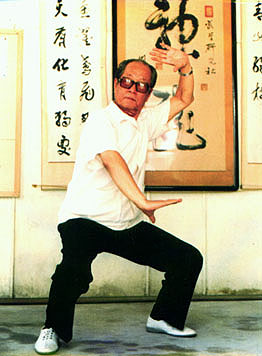
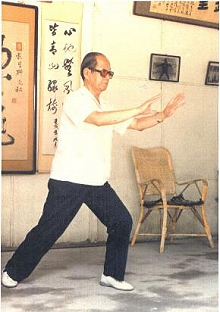
These two photographs — taken during Liú Yúnqiāo's teaching years in Taiwan — capture the philosophical duality at the heart of his martial legacy. Baji Quan represents the explosive, rooted yang force; Taijiquan, the yielding, flowing yin cultivation. Together they express his teacher Li Shu Wen's insight that hard and soft are not opposites but two faces of one complete practice.
From Retirement to the World's Largest Traditional Martial Arts Organization
Liú Yúnqiāo crossed to Taiwan in 1949 with the Republic of China government, serving in several staff and logistics positions before retiring as a colonel. For nearly two decades he lived quietly in a small three-room sugarcane-board house in Jǐngméi (景美), a suburban area of Taipei — conditions the Wu Tan biography describes with deliberate plainness as reflecting his complete personal integrity: he had served with distinction and retired with nothing.
The resurrection of his public martial arts life began through an accident: in 1966, the chance identification of a mutual acquaintance at Taipei's New Park reconnected Liu with his Shandong martial brother Zhāng Xiāng Sān (張詳三) — the sole custodian of Six Harmonies Mantis in Taiwan, who had been teaching at New Park for seventeen years without knowing Liu was on the island. Their reunion drew Liu back into Taiwan's martial arts world, and what had been dormant erupted.
By 1968 he was working with General Hú Wèikè (胡偉克) at the National Combat Committee, and was introduced to General Jiǎng Wèiguó (蔣緯國 — Chiang Kai-shek's son) who recognized him from their shared defense of Tongguan. That year Liu led the Republic of China National Martial Arts team to Malaysia as deputy team leader — performing charity exhibitions in Kuala Lumpur that raised funds for Malaysian social research while demonstrating Chinese martial arts to the diaspora community.
In 1968 Liú received the ultimate institutional endorsement: recommended by his military academy classmate General Kǒng Lìngshèng (孔令晟), he was received in audience by President Jiǎng Jièshí (蔣介石 — Chiang Kai-shek) and appointed Security Advisor to the Presidential Guard, training the President's personal bodyguards in Baji Quan. He later trained four cohorts of instructors at the "Joint Command Martial Arts Instructor Training Class" (Liánjǐbù Quánshù Shīzī Xùnliànbān 聯指部拳術師資訓練班) commissioned by President Jiǎng Jīngguó (蔣經國 — Chiang Ching-kuo), including the elite "Seven Seas Guard" (七海警衛) personal detail.
In June 1971 he founded 《武壇》雜誌 (Wǔtán magazine) and the 武壇國術推廣中心 (Wu Tan National Martial Arts Promotion Center) — and the trajectory was irreversible. By the time of his death, Wu Tan had over 3,000 direct disciples and branches in the USA, Japan, Malaysia, Venezuela, Spain, Switzerland, England, Belgium, Indonesia, and more. According to a Japanese survey conducted around 1990, Baji Quan was the most popular Chinese martial art in Japan after Chen-style Taijiquan — a phenomenon the Wu Tan primary record traces directly to Liu Yun Qiao's influence.
The Arts of Liú Yúnqiāo
The Wu Tan curriculum reflects the extraordinary breadth of Liú Yúnqiāo's personal martial education — each art received from one of the foremost masters of that system living in northern China during the 1920s–1940s. Together they constitute an integrated system that covers close-range explosive power (Baji), middle-range extending force (Pigua), circular evasion and transformation (Bagua), internal cultivation and yielding sensitivity (Taiji), and seizing-before-striking strategy (Mantis).
The "武壇光輝照耀寰宇" Generation
Wu Tan's inner-chamber disciples are ranked by the eight-character generational formula Wǔtán Guānghuī Zhàoyào Huányǔ (武壇光輝照耀寰宇 — "Wu Tan's brilliance illuminates the cosmos"), with each character representing one generation. The "武" (Wǔ) generation — the first — includes Liu's most senior direct disciples, many of whom went on to found their own schools, transmit internationally, and hold senior positions in Taiwanese cultural and academic life.
A remarkable aspect of Wu Tan's institutional culture was Liu's willingness to encourage cross-lineage exchange: disciple Chén Wēishēn, for example, studied with Zhāng Xiāng Sān for Mantis Fist through Liu's personal introduction, receiving the Wu Tan Baji curriculum from Liu and the Six Harmonies curriculum from Zhang simultaneously — a pattern that strengthened rather than diluted both transmissions. This philosophy produced a generation of exceptionally complete martial artists.
The Texts, the Manga, and the Plaque from a President
Liú Yúnqiāo published three major works during his lifetime: 《八極拳》 (1985, Chinese editions in Taiwan and Hong Kong, Japanese edition in Tokyo); 《昆吾劍譜》 (1990, two volumes); and a curriculum compilation prepared for the Chinese Martial Arts Association in 1989. At the time of his death, a manuscript titled 《劈掛掌》 was in final review — an unfinished monument to his lifelong study of that art.
The most unexpected dimension of his cultural legacy was through Japanese popular culture. His grand-disciple Matsuda Ryūchi (松田隆智), the Japanese martial arts author and researcher who had trained directly with Liu in Taiwan, co-created the manga series Kenshiro (拳兒, 1988–1992) — serialized in Shōgakukan — which depicted Liu Yun Qiao's life story in thinly veiled fictional form under the name "Liú Yuèxiá" (劉月俠). The manga sold millions of copies across Japan and Taiwan, and became for a generation the primary way people encountered the tradition of Baji Quan. It is a remarkable irony that a martial art transmitted across China's provinces and surviving the 20th century's upheavals ultimately reached its largest modern audience through a Japanese cartoon.
Similarly, Wong Kar-wai's celebrated 2013 film The Grandmaster (一代宗師) drew on Liu Yun Qiao's biography for the character "Razor" (一線天, played by Chang Chen) — the Baji Quan master and wartime intelligence operative who fights without mercy and lives in secrets. The film's creative team explicitly identified Liu as one of the historical sources for this character.
When Liú Yúnqiāo passed away on January 24, 1992, in Taipei's Cathay General Hospital at age 84, the funeral was attended by nearly a hundred senior officials of the party, government, and military. President Lǐ Dēnghuī (李登輝) personally sent a memorial inscription: 「武學貽徵」 (Wǔ Xué Yí Zhēng) — "The Martial Teachings Leave Their Mark." Four characters from the President of the Republic of China — for a man who had spent his life in service to that nation with a martial artist's absolute commitment.