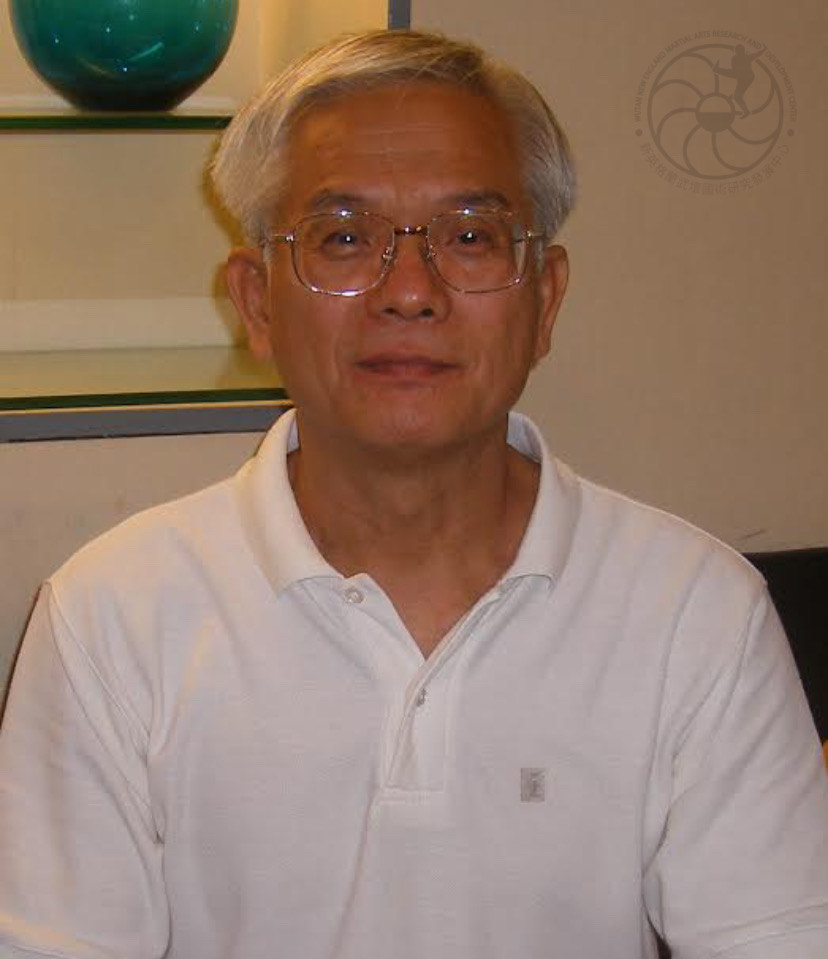
戴士哲 Dài Shìzhé — Master of Baji, Bagua & Six Harmonies Mantis
Master Dài Shìzhé 戴士哲
戴士哲老師 · Master Dài Shìzhé
Master · 武術家 · Wu Tan "武" Generation
戴士哲
Dài Shìzhé
b. 1941  ·  台灣 · Taiwan  ·  Training began age 11
武壇「武」字輩 · 師承兩位宗師  ·  Discipled to two grandmasters · 1972
八極拳 · Baji Quan 劈掛掌 · Pigua Zhang 八卦掌 · Bagua Zhang 六合螳螂拳 · Six Harmonies Mantis 形意拳 · Xing Yi Quan 委內瑞拉 · Venezuela 1976–1987 17,000+ Students · 17家分館

A Lifetime in Martial Arts — Two Lineages, One Complete Education

南北兼修 · 師承兩位宗師

Dài Shìzhé (戴士哲) was born in 1941 into a family with a long martial arts heritage. His formation is unique in the history of the tradition: he came to northern Chinese martial arts already carrying deep roots in the southern systems, and ultimately received the formal discipleship of two of Taiwan's greatest masters. Liú Yúnqiāo (劉雲樵) — the closed-door disciple of "Divine Spear" Li Shu Wen and founder of Wu Tan — received him as a Wu Tan inner-chamber disciple of the "武" (Wǔ) generation, transmitting the complete Li Shu Wen lineage of Baji Quan, Pigua Zhang, and Gong-style Bagua Zhang. Zhāng Xiāng Sān (張詳三) — the sole custodian of Six Harmonies Mantis Fist in Taiwan — transmitted the complete Six Harmonies and Seven Stars Mantis curricula, and listed Dài first among his 31 formal disciples. This dual discipleship from two independent masters of the highest caliber defines the unusual completeness of Dài's martial transmission.

A practitioner who has trained throughout his life in Mantis, Baji, Pigua, Bagua, and Xing Yi — with Six Harmonies Mantis and Bagua Zhang as his most refined specialties — Dài has insisted on practicing every single day into his eighth decade of life. For nearly six decades he has embodied the Wu Tan ideal of complete, multi-system martial education — and through his eleven years in Venezuela, carried that tradition across the globe.

From Southern Roots to Northern Mastery

南拳奠基 · 北藝深造 · 拜師禮

Dài Shìzhé's martial journey began at age eleven, guided by family elders who taught him the traditional martial arts of the Southern Fujian (Mǐn Nán 閩南) systems — a curriculum that included Tàizǔ Quán (太祖拳 — Great Ancestor Fist), Hè Quán (鶴拳 — Crane Fist), Yǒng Chūn (詠春 — Wing Chun), and Dà Zūn Quán (大尊拳). These southern arts — rooted in the coastal Fujian tradition with its emphasis on close-range striking, powerful bridging arms, and simultaneous attack-defense — gave him a structural foundation in real combat method that would later inform his absorption of the northern styles.

In 1964, Dài Shìzhé encountered Zhāng Xiāng Sān (張詳三) — the sole custodian of Six Harmonies Mantis Fist in Taiwan, who had been teaching daily at Taipei's New Park for fifteen years. This meeting began his immersion in northern martial arts and in the specific character of the soft Mantis tradition. Two years later, in 1966, senior Wu Tan disciple Liáng Jìcí (梁紀慈) — first of Liu Yun Qiao's Wu Tan generation — introduced him to Liú Yúnqiāo (劉雲樵), and Dài began training in the complete Wu Tan system of Baji Quan, Pigua Zhang, and Bagua Zhang.

In 1972, both grandmasters agreed to formally accept Dài Shìzhé as an official disciple in a bàishī ceremony (拜師 — literally "bow to the teacher") — the defining transition from student to disciple. He was accepted by Zhāng Xiāng Sān as the first in rank among his 31 inner-chamber disciples, becoming the 7th Generation of Six Harmonies Mantis Fist; and by Liú Yúnqiāo as a member of the "武" (Wǔ) generation of the Wu Tan Martial Arts Development Center. The photograph below captures this historic moment.
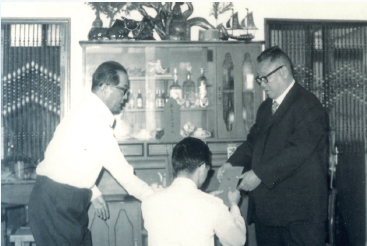
Dài Shìzhé Bàishī ceremony with Masters Liú Yúnqiāo (left) and Zhāng Xiāng Sān (right) — 1972
The bàishī ceremony — Dài Shìzhé with his two masters: Liú Yúnqiāo (left) and Zhāng Xiāng Sān (right), Taiwan, 1972
拜師典禮 · 1972年 · 台灣

The significance of this double-discipleship extends beyond the personal. It meant that when Dài Shìzhé transmitted to his own students, he carried two complete lineage streams that had historically been separate — the Wu Tan Baji-Pigua-Bagua system from Liú, and the Six Harmonies Mantis system from Zhāng. His eight years of training before the ceremony (1964–1972) — first in southern arts under family elders, then in northern arts under both grandmasters — meant that by the time of the formal bàishī, he had already developed a remarkable breadth and depth of martial understanding.

Five Arts, Two Masters, One Complete System

五門武藝 · 兩師一體

Dài Shìzhé's martial education spans two great regional traditions. His southern foundation — Taizu Quan, Crane Fist, Wing Chun, and Da Zun Quan from family elders — gave him roots in the close-range, structurally powerful Fujian systems. His northern training under Zhāng Xiāng Sān and Liú Yúnqiāo added the long-range explosive power of Baji, the windmill arcs of Pigua, the circular walking of Bagua, and the seizing strategy of Six Harmonies Mantis. Six Harmonies Mantis and Bagua Zhang emerged as his two supreme specialties — arts he has studied and practiced for over fifty years at the highest level.

Primary Art · From Liú
八極拳 Bājí Quán · Eight Extremes Fist
From Liú Yúnqiāo 劉雲樵 — the complete Li Shu Wen lineage, including the Six Grand Openings (六大開) in their integrated form with Pigua Zhang.
Twin Art · From Liú
劈掛掌 Pīguà Zhǎng · Splitting-Hanging Palm
From Liú Yúnqiāo 劉雲樵 — inseparable from Baji in the Li Shu Wen transmission; the long-range whipping complement to Baji's explosive close entry.
Supreme Specialty · From Liú
八卦掌 Bāguà Zhǎng · Eight Trigrams Palm
From Liú Yúnqiāo 劉雲樵 — Gong Bao-tian's Yin-style lineage. Through this art Dài realized the three-character virtue of Truth, Kindness, and Beauty (真善美). His most deeply developed internal art.
Supreme Specialty · From Zhāng
六合螳螂拳 Liùhé Tánglángquán · Six Harmonies Mantis
From Zhāng Xiāng Sān 張詳三 — 7th Generation. Listed first among Zhang's 31 formal disciples. Includes all six form sets, weapons, and the 93-technique secret hand formula's organizing principles.
Additional Art
形意拳 Xíngyì Quán · Form-Intent Fist
Within the Wu Tan curriculum — the direct, linear power-expression complement to Bagua's circular evasion and Taiji's yielding, completing the internal arts triad.
Additional Mantis · From Zhāng
七星螳螂拳 Qīxīng Tánglángquán · Seven Stars Mantis
From Zhāng Xiāng Sān 張詳三 — transmitted as part of Zhang's dual Mantis curriculum, including Méihuā Lù (梅花路) and Zhāiyào (摘要) routines.

On Six Harmonies Mantis & the Realm of Bagua

論六合螳螂與八卦掌:真善美境界
「螳螂分做硬螳螂跟軟螳螂。硬螳螂就是七星螳螂,我們所謂七星梅花。軟螳螂是,都是纏絲勁,纏絲勁,發勁比較沒有那麼猛烈。柔最後會變剛,變成剛柔相繼,剛最後一定要化到柔,也一樣要剛柔相繼。等於陰陽柔合,合成一體了,然後那個勁一出來,那個念一動,他的勁出來,人就到了。」
"Mantis divides into Hard Mantis and Soft Mantis. Hard Mantis is Seven Stars — what we call 'Seven Stars Plum Blossom.' Soft Mantis is entirely silk-reeling force (chán sī jìn 纏絲勁) — its force expression is less explosive. The soft will ultimately become hard, the hard must ultimately return to soft — this mutual succession of hard and soft: it is like Yin and Yang merging into one body. Then when that force comes out, when the thought moves — the force arrives, and the person is already there."
— Dài Shìzhé 戴士哲 · On Six Harmonies Mantis Fist · 六合螳螂拳論
Truth · 真
Zhēn — Authenticity
Through Liú Yúnqiāo's Bagua Zhang, Dài realized the three-character virtue formula Zhēn Shàn Měi (真善美 — Truth, Kindness, Beauty). Zhēn — truth — is the practitioner's commitment to authentic transmission: what the master actually taught, not what is convenient, not what is popular, not what has been simplified for mass appeal. Authenticity in martial arts is simultaneously technical and moral.
Kindness · 善
Shàn — Universal Benefit
On Shàn, Dài said: "Kindness is not only about improving oneself — it extends to benefiting all people (jiān shàn tiānxià 兼善天下). A person who practices Bagua well often smiles constantly, radiating a quality of delight. That joy naturally influences the people around them — it becomes a way of universally benefiting others." This is why he taught: not for profit or fame, but because genuine transmission is itself an act of generosity.
Beauty · 美
Měi — Aesthetic Cultivation
The Měi — beauty — of martial arts is not decorative. It is the aesthetic of precise function: a technique that is maximally effective is also, by the logic of Chinese martial philosophy, maximally beautiful. The body moving in complete alignment with biomechanical principles — rooted, relaxed, connected — produces movement that is as beautiful to observe as it is effective in application. Beauty and truth are the same thing seen from different angles.

Dài has described his teaching method as the direct continuation of what his masters taught him: "I first recite the formula (kǒujué 口訣), then guide the student through the key principles. This is the method my teacher used to transmit the art — so I must pass these traditions to my own students." He has expressed his deepest hope: "I hope my students will be able to transmit everything that is truly ours — completely — not just the technical side, but the spirit."

Eleven Years, Seventeen Schools, Seventeen Thousand Students

十一年 · 十七家分館 · 一萬七千學生

In 1976 (Republic of China calendar year 65), Dài Shìzhé was recommended by the Overseas Chinese Affairs Commission (Qiáo Wěi Huì 僑委會) of the Republic of China government to travel to Venezuela and teach traditional Chinese martial arts to the overseas Chinese community there. What began as a government-sponsored cultural mission became an extraordinary eleven-year chapter in the global transmission of Chinese martial arts.

11 years in Venezuela  ·  委內瑞拉十一年
17 branch schools opened  ·  開設分館十七家
17,000+ students taught  ·  學生逾一萬七千人
These figures — drawn from Dài's own account — represent one of the largest single-person Chinese martial arts teaching efforts in Latin American history. Across eleven years Dài established 17 branch schools throughout Venezuela, building a permanent institutional presence for traditional Chinese martial arts in a country with no prior tradition of them. Over 17,000 students passed through his instruction — the overwhelming majority of whom were non-Chinese Venezuelans, making this one of the most significant cross-cultural transmissions of Chinese martial arts in the 20th century.

The Overseas Chinese Affairs Commission's recommendation of Dài for this mission reflected the Republic of China government's recognition of his standing as one of Taiwan's foremost traditional martial arts ambassadors. His dual lineage from both Liú Yúnqiāo and Zhāng Xiāng Sān — covering the complete spectrum from Baji Quan's explosive close-range combat to Six Harmonies Mantis's internal silk-reeling sensitivity — gave him a curriculum broad enough to serve a diverse population with varied interests and physical profiles.

When Dài returned to Taiwan after those eleven years, he brought with him something that could not be counted: decades of teaching experience across cultures, in a language not his own, with students whose bodies moved differently and whose martial arts intuitions had been formed by an entirely different physical culture. That cross-cultural teaching experience informed everything he did in Taiwan afterward — including his ongoing willingness to teach international students who found their way to his door.

Transmission Across Continents

台灣會面 · 2006年

When Luis Mendez traveled for the first time to Taiwan in 2006 to meet and deepen his training with Master Dài Shìzhé — studying directly at the source of the transmission that had reached him through Yuri Jimenez and with his authorization — this photograph taken after a long day of practice captures something important: the lineage chain made visible in a single image. What had passed from the old masters to Dài Shìzhé now reaching across the Pacific to Venezuela and the United States of America through a student who had crossed the ocean to stand face-to-face with his teacher's teacher.
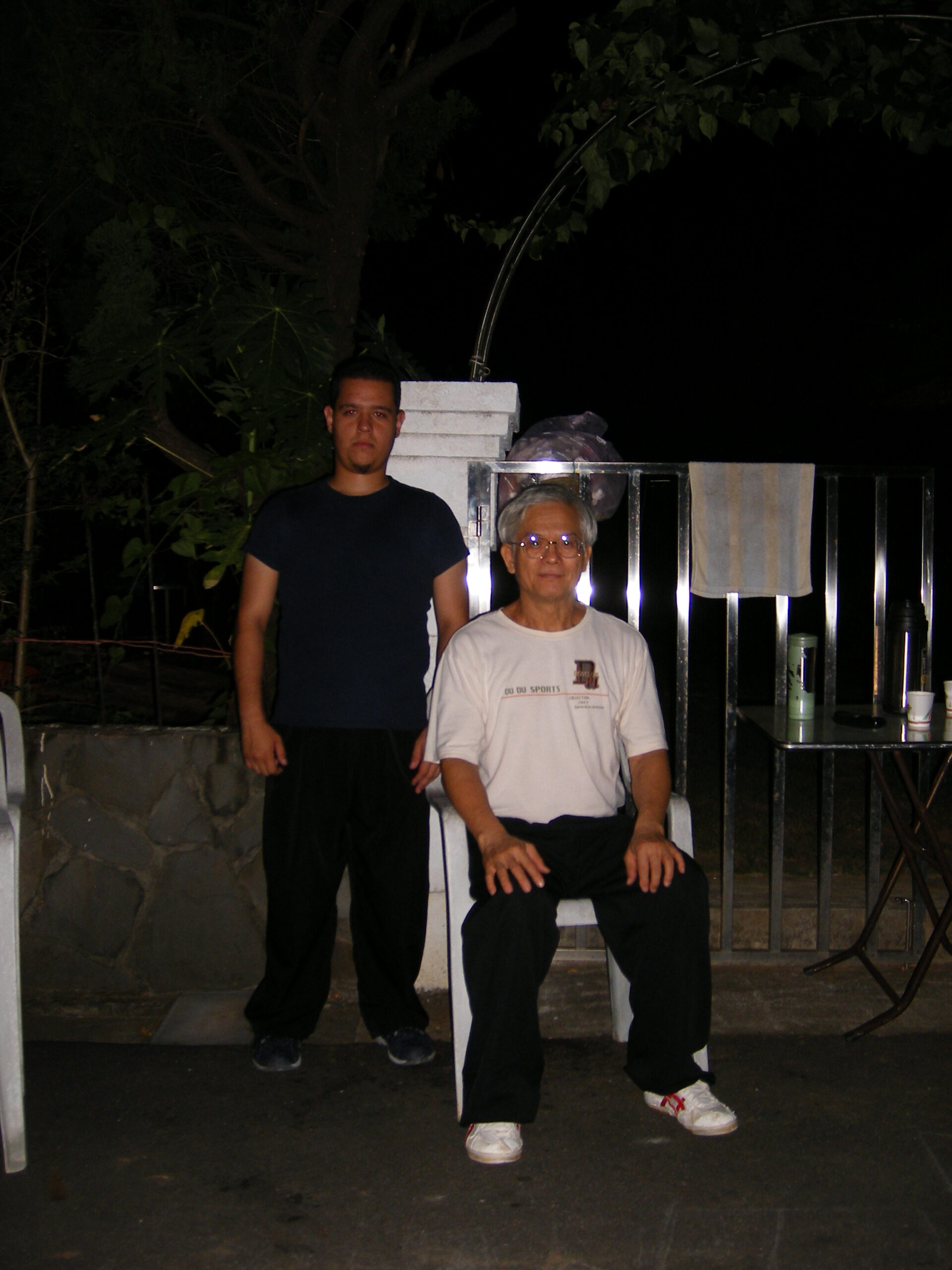
Luis Mendez with Master Dài Shìzhé in Taiwan, 2006
路易士·門德斯與戴士哲老師合影
台灣,2006年
Luis Mendez with Master Dài Shìzhé in Taiwan, 2006 — a visit that deepened the transmission connecting Wu Tan New England to the source lineage in Taipei.
Wu Tan New England · The Living Lineage

From Li Shu Wen to The USA

從神槍李書文到美國

Dài Shìzhé stands at the center of the transmission chain that connects the founding generation of northern Chinese martial arts in the early 20th century to the students of Wu Tan New England today. Every technique in the school's curriculum — every Baji explosion, every Pigua arc, every Bagua spiral, every Mantis seizure — carries within it the direct lineage that runs through his hands.

李書文 Lǐ Shūwén Divine Spear
劉雲樵 Liú Yúnqiāo Wu Tan Founder
戴士哲 Dài Shìzhé Our Teacher
Yuri Yuri Jimenez Direct Disciple
Luis Luis Mendez Wu Tan NE
+ Zhāng Xiāng Sān 張詳三 → Dài Shìzhé · Six Harmonies Mantis lineage stream

Master Dài Shìzhé in His Own Words

戴士哲老師接受新唐人電視台專訪

This interview segment was produced by New Tang Dynasty Television (新唐人電視台, NTD) for the NTD International Traditional Chinese Martial Arts Competition (全世界華人武術大賽) — the largest international competition dedicated exclusively to authentic traditional Chinese martial arts, held in New York. In this interview, Master Dài demonstrates Bagua moves singing a classic Chinese poem and speaks directly about his understanding of the art's principles: the distinction between hard and soft, the nature of silk-reeling force, the philosophy of Bagua's Truth-Kindness-Beauty, and his aspirations for transmission to the next generation.

Master Dài Shìzhé 戴士哲 · Interview Excerpt
Courtesy: New Tang Dynasty Television (NTD) · 新唐人亞太電視台 · NTD International Traditional Chinese Martial Arts Competition · 全世界華人武術大賽

A Life Devoted to Transmission

傳藝一生
1941 · Taiwan
Born in Taiwan into a family with a long martial arts heritage — a lineage of practitioners that ensured his early immersion in the arts would begin within the family itself.
c. 1952 — Age 11 · Southern Fujian Arts
Begins formal martial arts training under family elders in the traditional Southern Fujian systems: Tàizǔ Quán (太祖拳 — Great Ancestor Fist), Hè Quán (鶴拳 — Crane Fist), Yǒng Chūn (詠春 — Wing Chun), and Dà Zūn Quán (大尊拳). These arts give him deep roots in close-range, structurally powerful southern combat method.
1964 — Meets Zhāng Xiāng Sān
Encounters Zhāng Xiāng Sān (張詳三) — sole custodian of Six Harmonies Mantis Fist in Taiwan — and begins training under him in northern martial arts. This begins his eight-year journey toward formal discipleship, and his immersion in the soft Mantis tradition's internal silk-reeling principles.
1966 — Introduction to Liú Yúnqiāo
Senior Wu Tan disciple Liáng Jìcí (梁紀慈) — first of Liu's Wu Tan generation — introduces Dài Shìzhé to Liú Yúnqiāo (劉雲樵). Dài begins training in the Wu Tan system of Baji Quan, Pigua Zhang, and Gong-style Bagua Zhang under the grandmaster.
1972 · The Bàishī Ceremony
Both grandmasters agree to formally accept Dài Shìzhé as an official disciple. He becomes the first in rank among Zhāng Xiāng Sān's 31 inner-chamber disciples — 7th Generation of Six Harmonies Mantis Fist — and a member of the "武" (Wǔ) generation of the Wu Tan Martial Arts Development Center under Liú Yúnqiāo.
1972–1976 · Wu Tan Senior Years
Deepens training as a formal disciple of both masters, developing the Bagua Zhang cultivation that becomes one of his supreme specialties.
1976 · Recommended for Venezuela Mission
Recommended by the Republic of China's Overseas Chinese Affairs Commission (僑委會) to travel to Venezuela as a Chinese martial arts cultural ambassador to the overseas Chinese community there. Departs for South America carrying the complete Wu Tan curricula.
1976–1987 · Venezuela
Over eleven years, establishes 17 branch schools throughout Venezuela, ordeins 4 groups of closed-door disciples and trains over 17,000 students — the vast majority non-Chinese Venezuelans. This becomes one of the largest single-person Chinese martial arts teaching efforts in Latin American history, and one of the most significant cross-cultural transmissions of these arts anywhere in the 20th century.
1982 · Zhāng Xiāng Sān Passes
Master Zhāng Xiāng Sān passes away on February 24, 1982 in Taipei. At the memorial altar on March 17, Liú Yúnqiāo accepts two additional disciples in Zhang's name — a gesture of posthumous fraternal devotion that also reflects the deep interconnection between the two lineages Dài now carries.
1987 · Return to Taiwan
Returns to Taiwan after eleven years in Venezuela. Resumes active teaching in Taipei, continuing as a senior presence in both the Wu Tan community and the Six Harmonies Mantis lineage network established by Zhāng Xiāng Sān's disciples.
1992 · Liú Yúnqiāo Passes
Liú Yúnqiāo passes away on January 24, 1992, in Taipei. As a Wu Tan "武" generation disciple, Dài is among the senior surviving carriers of the complete Li Shu Wen lineage as transmitted through Liu.
2006 · Taiwan Visit with Luis Mendez
Luis Mendez travels for first time to Taiwan to train directly with Master Dài — a visit that deepens the lineage connection with the source transmission in Taipei.
2008 · Taiwan — Summer Training
Luis Mendez travels to Taiwan for a second time to practice with Master Dài Shìzhé during the summer months — continuing to deepen his training directly at the source and strengthening the bond with the Taipei transmission.
Present Day · Taiwan
Dài Shìzhé continues to reside and teach in Taiwan, cultivating the next generation of traditional martial artists. Through Yuri Jimenez and Luis Mendez, his transmission of the complete Wu Tan curricula reaches Venezuela and the USA — where his lineage continues to live in the bodies of his martial descendants.

戴士哲老師 · Master Dài Shìzhé · b. 1941

武壇「武」字輩 · 六合螳螂拳第七代傳人

Wu Tan "Wǔ" Generation · 7th Generation Six Harmonies Mantis Fist

Received from: Liú Yúnqiāo 劉雲樵 (Baji, Pigua, Bagua) & Zhāng Xiāng Sān 張詳三 (Six Harmonies Mantis)
Transmitted to: Yuri Jimenez → Luis Mendez · Yun Hai Wutan and Wu Tan New England

Primary sources: 六合螳螂拳張詳三傳承弟子 (6h-mantis.org, Taiwan) · 中華武壇國術推廣協會 wutang.tw · 六合螳螂拳第六代傳人張詳三先生小傳 (6h-mantis.org) · 中文維基百科 劉雲樵 (zh-TW) · Xuite 日誌八極拳傳承記錄